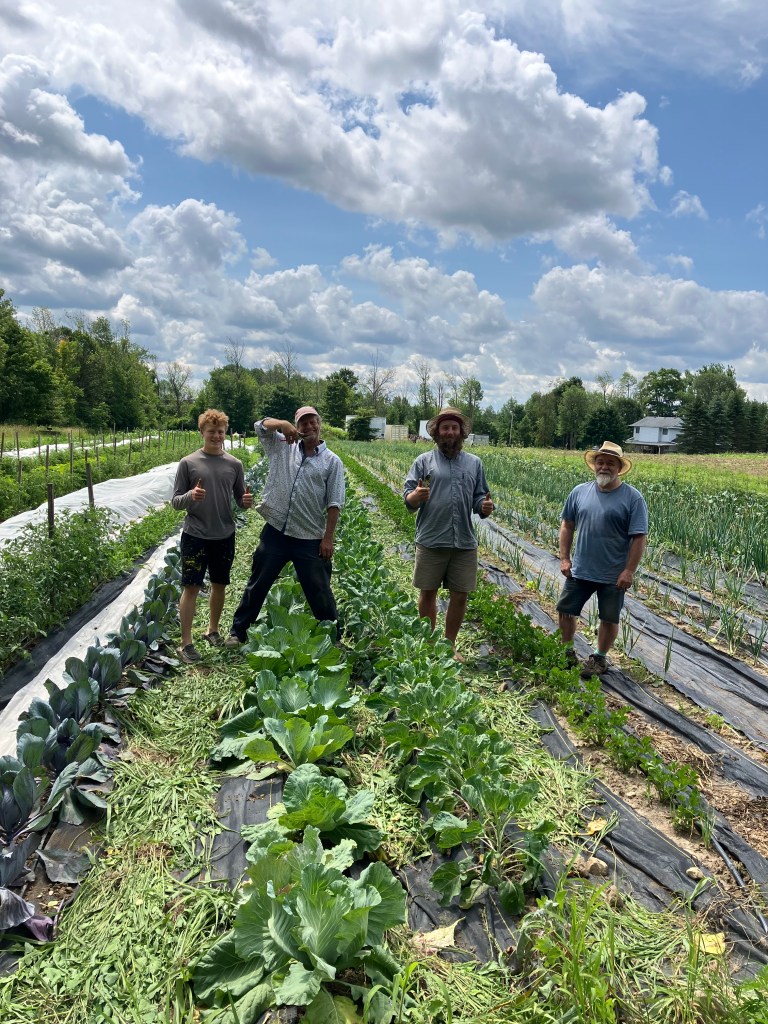
On a lovely afternoon, light breeze, filtered sun, many hands from good people came together to make light enjoyable work. We got all the outside peppers and tomatoes in the ground then enjoyed an amazing potluck. Next scheduled event will be our weeding party Saturday July 20, 9-12 with a potluck lunch. Hope others can make it out.
The first of our three planned community events at the farm is this Saturday June 1st. We will have a planting party from 2-5pm followed by a pot-luck dinner. It looks to be a beautiful day. If you don’t want to, or can’t make it to the planting part, feel free to just come for the pot-luck. Please bring your own dishes and cutlery.
For those who do come for planting, there’s also mulching if you don’t do well on your hands and knees. If you have a pitch fork, or trowel, it would be helpful if you could bring them. We have several here, but maybe not enough. Depending on who’s here and how the day goes there might even be tomato post pounding… so many fun opportunities!
If you have any questions, let us know… Hope to see you here!
Transformation: greenhouse turns from spring greens to summer crops of peppers, basil, and beets.
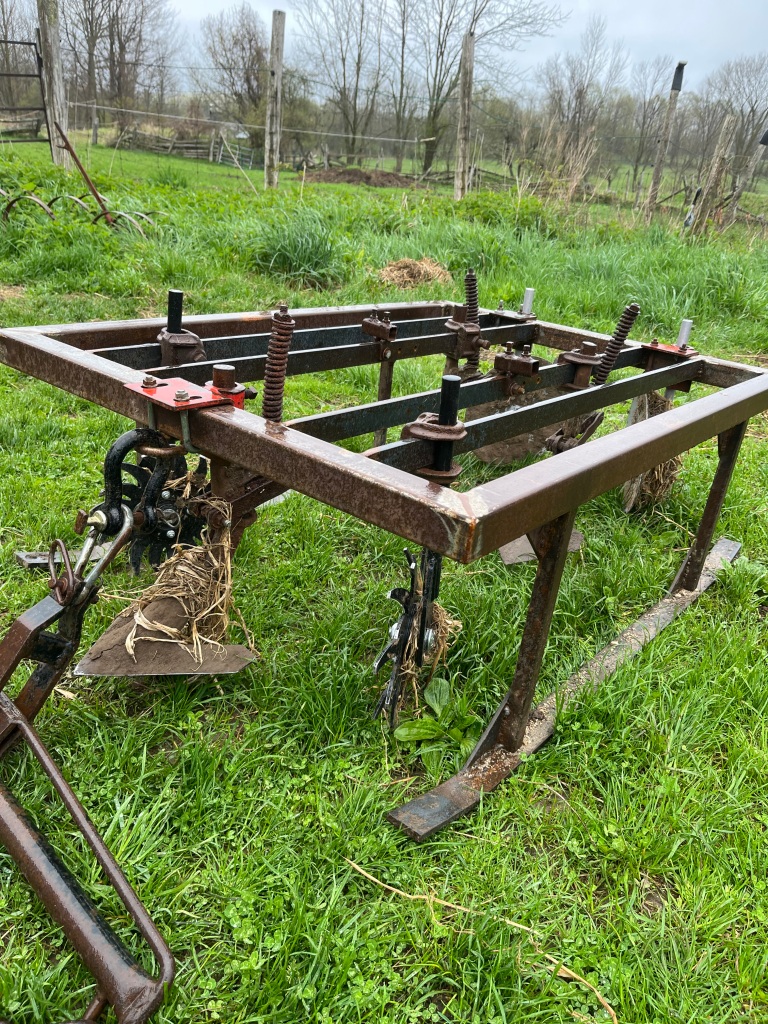
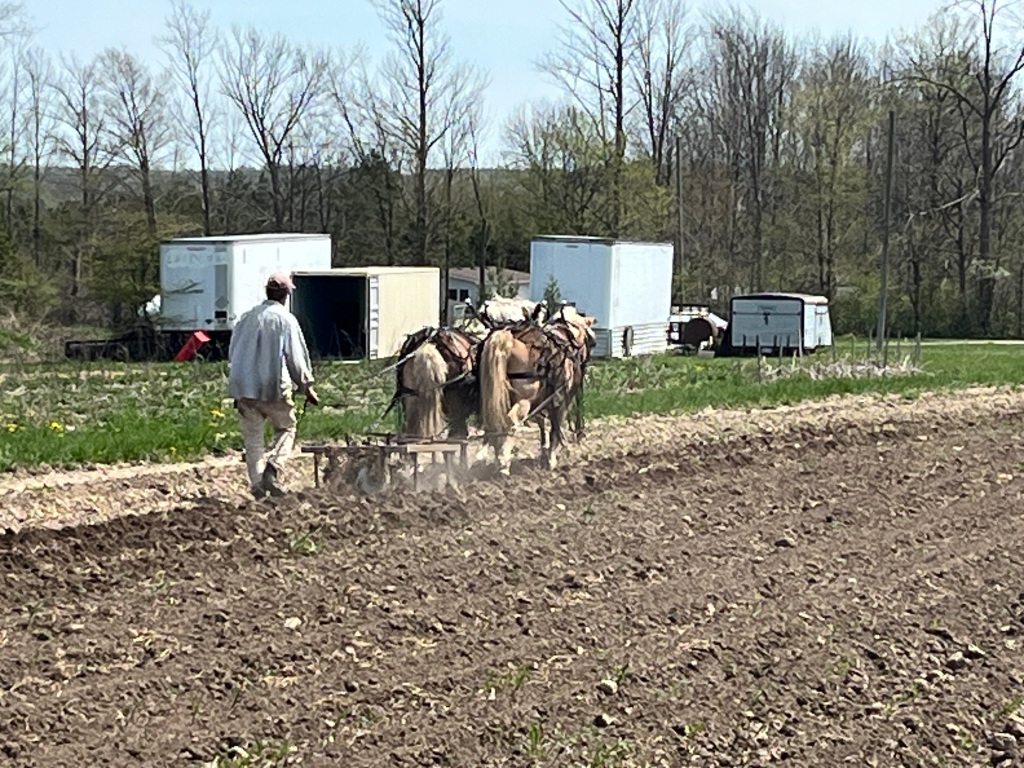
Will see some of you today for the Spring CSA, but also wanted to share a quick note about the spring. I’m grateful that I have been working with premade beds, since, as is common, we have a wet spring and preparing beds between the rains would be, and has been challenging. Part of the pre-made beds issue that I’ve run into in the past is that if the spring is very wet the weeds start taking off before I can even scratch the surface of the bed to plant. Last year I had the idea of a horse implement that I could use to do this. The implements I have used with the previous horses I can’t use with the horses that are here now (that’s a bit of a long story). I designed it and had it fabricated and am trying it out for the first time this spring. Not a lot of time for experimentation, but with continual tweaking it’s coming along.
Still trying to come up with a name for the tool… any ideas?
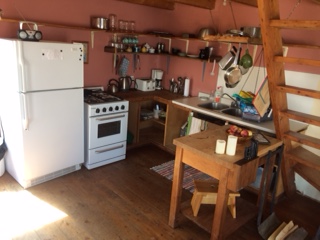
The cabin above our root cellar is available for short term rentals from early May to the end of July. If you know anyone needing a weekend here or a week there in need of a place to stay you can have them contact me at saugeenrivercsa@gmail.com or 519 369 3567.
Next week I’ll be starting up the greenhouse, seeding the first flats for the Spring CSA. There are no more Spring shares available, but there are still plenty available for the main summer season.
To peat or not to peat has been an eternal question! We have been using raw peat moss in our greenhouse seedling mix since we began. Peat is a renewable resource, but can be exploited, and the harvesting of it can be damaging to wetlands. When I was on the board of Demeter Canada back in 2000, I was asked to do research on peat. What I found at that time was that Canadian peat was developing faster than it was being harvested. Which means that peat moss was forming in natural habitats faster than it was being extracted. In the US, peat was being harvested faster than it was developing. Like fossil fuels, we’ve tried to limit the amount of peat we use, while at the same time exploring alternatives. From 1997-2002 we made a separate leaf mold compost to replace some of the peat in our mix. This worked pretty well, but was labour and time intensive. We had to gather hardwood leaves in the fall, chop them fine with a lawnmower, and layer them with nettle plants (to reduce the acidity). They would take a year and a half before they composted enough for us to sift them and add them to our mix. During that time there was a fad that promoted coconut fiber as a peat alternative. This has its own ecological questions, and we found it didn’t work well in our mix anyway. After getting horses on the farm in 2010, I observed the way the piles of horse poo in the pasture would break down. It looked a lot like peat. We tried drying it and sifting it and experimented with replacing the peat moss. Again, the plants did not respond well. Maybe more experimenting would lead to something, but my gut doubted it. Now a new product is just coming into the market: EcoWool, pelletized wool fibers that are suggested to be used as a peat alternative. My friends, Jennifer and Tim (biodynamically minded sheep farmers) from All Sorts Acres just north of Mt. Forest have begun producing it (see picture below). I’ve gotten some from them to experiment with this year. This is a great development for the wool industry that has struggled to know how to survive. If you purchase peat for your garden, I’d highly recommend trying some out. But for me, here’s the rub: right now I purchase about three bales of peat moss a year, costing about $50. That’s all I need. If I were to substitute the EcoWool one for one, I’m guessing it would cost around $2,000. I’ll be doing some experimental soil mix recipes to see if there is a way to make it work.
This past season saw perhaps the best onion harvest we’ve had. They were larger than other years and still so tasty. Because of their size, we could give out fewer of them and give you more at the same time. Because of that, even though we grew the same (actually a bit less) row feet, there were more. Most of this I would subscribe to the added fertility that the chicken wagon adds going through the rest areas the year before. However this might have a consequence. This extra fertility might make them bigger, but might also make them not store as well. We don’t have the best onion storage anyway, but they usually keep through early spring. But this past season also saw an unusually wet August (remember the tomato late blight?). So just as the storage onions were sizing up, there was maybe too much water. This would impact their storage. All this to say, the onions are starting to go off. We have an abundance of them, so I will offer them free choice (as still one of the items). We’ve been eating the off ones, and they are starting to go bad from the outside. So the one or two outer layers might be no good, but the inner layers are fine. It’s sometimes hard to tell before peeling it. So feel free to take extra and make use of what we have. Onion soup? Caramelized onions with every meal?
Happy New Year! Reminder, we have another Winter CSA pick-up this Friday January 5. We’re already half way through the Winter season! Also, a reminder, as in other years the month of January I reserve for return members to rejoin for the coming Spring CSA and Main Season CSA. There is a waiting list for the Spring shares, so make sure you let me know if you are planning to rejoin. In February if the CSA is not full I’ll open it up to new members. Many of you have already signed up for this coming year, thank you. If you are not able to make a first payment right now that’s fine, just let me know your intentions for the coming spring and summer. The main seed order is scheduled to arrive this Friday. In about a month’s time I’ll be starting the seedlings for the spring greens! In the meantime, I’ll be catching up on bookkeeping, and finalizing the greenhouse and garden plans for this season. Welcome winter,
Last post for 2022! Reminder of Winter share pick-up this Friday December 30 2 – 6pm!
Each year, around winter solstice, we sing Christmas Carols to the cows and horses in our barn. It’s a small thing, not a production, or performance (our harmonies could only be loved by cows), but it holds a special place, a sacred place in my heart. I’ve been doing it every year since my apprentice days, whichever farm I was part of that time of year. It doesn’t have to be Christmas Carols, it could be a Hanukah celebration, or Dong Zhi, or Yalda Night, or any acknowledgement of the Sun’s lowest rise on the horizon, and the beginning of the longer days. The meaning of the simple practice has deepened over the years. It relates to the very special place manure holds in agriculture. In the darkest time of year, all the plants are dormant in seed or cambium. The outer Sun offers not much warmth. But the cows have the warmth of the Sun inside them, held, cherished, by the metabolism, giving them warmth in their blood. Chewing their cud, resting on the bedding in the barn, the warmth they are nurturing is precious. They are masters of digestion, some of the only beings able to extract nourishment from cellulose. They give more than they take. If handled with care, the fertility they bring to the land provides for generations. When we sing to them we are honoring their gift of giving more then they take. We collect and protect that gift in the compost. We spread that gift on the soil. We tend that gift of fertility in our crops. We sing to the cows in hopes that their gift is carried in the food we all receive from the land, that you can carry that inner warmth in all you bring to the world.
Thank you for all your support this past year, and wish you well for 2023!
Happy New Year everyone! With so much uncertain in the world, one thing I can say is that the days are already getting longer, and seeds have begun arriving for the coming season! As in other years, I start signing up previous members in the month of January. In February I open shares up to others if there’s space. Many of you have already signed up, but for those who have not, if you could at least let me know your intention if you want a share this season. Winter plans are underway, and neglected bookkeeping. I’ll post more details about the coming season soon…
A group of biologists from Bird Ecology and Conservation Ontario have been studying ground nesting birds (Bobolinks, Eastern Meadowlarks, and Grasshopper Sparrows) in this area for several years. This past year they did a study of our farm, among others. Their goal is to help farmers develop pasture and haying practices that can take into consideration the needs of these endangered birds. It was a great experience to learn how adjusting grazing and cutting timing can make it more possible for these birds to raise their young. I’ve attached the report they gave me about the farm. They also recorded all the bird species they observed here (47 total!).